Rainmaker Sacrifice Custom
The Glass Bead GameRainmaker Sacrifice Custom is the village tradition of sacrificing its Rainmaker when severe drought or prolonged rain persists despite other attempts to avert crop failure. It stands at the dangerous edge of an office devoted to reading natural signs and sustaining the community: when the Rainmaker’s work appears to fail, the same people he serves may demand his death, while his sacrifice is believed capable of placating the powers and breaking the disaster’s hold.
Origins and Ritual Authority
The custom belongs to a village order in which weather, planting, and spiritual authority are closely linked. The Rainmaker’s most important regular duty is to use the moon’s phases, inherited rules, and personal experience to determine when the community should sow. But he does not perform the opening act of the sowing season: the tribal mother, or her oldest female relative, scatters the first handful of grain and seeds. The division of duties places the Rainmaker’s specialized knowledge within a broader social order rather than making him sole authority over communal life.
In ordinary conditions, the Rainmaker lives much like other villagers and receives payment when called upon for community service. His prominence rises when a long drought or persistent cold and damp threatens famine. He then leads sacrifices, exorcisms, processions, and other ceremonies intended to influence the forces blamed for poor weather. According to village legend, if persuasion, pleas, and threats fail, sacrificing the Weathermaker is the last infallible remedy. The tribal mother is said to have witnessed such a sacrifice in the age of the mothers and grandmothers, connecting the custom to remembered communal history.
Belief and Obligation
The custom is not simply a response to a failed forecast. It expresses a belief that a crisis in nature may demand a human offering when other ritual means have proved ineffective. The Rainmaker’s authority depends partly on practices grounded in observation—especially the study of the moon, whose phases guide the sowing calendar—but his office also includes ceremonies directed at spirits and forces beyond ordinary control. The tradition binds practical responsibilities and supernatural expectations together, leaving the Rainmaker answerable for outcomes he cannot command.
That obligation is sharpened by the village’s conception of the moon as a place associated with the dead and renewed birth. In Knecht’s instruction, the waxing and waning moon is not merely a calendar for farming: it is connected to the souls of the dead, who go forth into new births to make room for the newly dead. Against that background, the prospect of the Rainmaker’s death can be understood within a larger cycle of death and return, though the custom’s immediate promise is more concrete: the sacrifice is supposed to placate the powers and end the agricultural calamity.
Knecht’s Acceptance of the Custom
Knecht’s own experience gives the inherited rule a personal and political weight. During an earlier period of two years of failed crops and adverse weather, the villagers suffered hunger, and his ceremonies could not prevent the crisis. When the community’s fear revived the belief that sacrificing the Weathermaker was necessary, Knecht offered himself rather than opposing the custom. He also worked to relieve the hardship, finding water and preventing the villagers from slaughtering all their livestock. The ordeal ended with greater respect among those able to judge his conduct, showing that his service did not depend only on successful rainmaking.
In the later drought, Knecht again recognizes that the custom may cost him his life. He tells his son Turu that, if he is sacrificed, Turu must take over his office immediately, have his body burned, and scatter the ashes over the fields. He also instructs him to protect the community’s seed grain, despite the hunger expected through the winter. These directions link the sacrifice not only to placating the demons but to preserving the conditions for a future harvest.
The Sacrifice and Succession
As drought deepens and the village’s ceremonies fail, Maro incites the people and presses the tribal mother to demand Knecht’s death. Knecht responds by bringing Turu, dressed in the ceremonial robes, to the tribal mother and proposing him as successor while offering himself as the sacrifice. She assents. The transfer of office is therefore arranged before the ritual killing: Knecht’s decision aims to leave the village with a Rainmaker who can carry its knowledge and responsibilities forward.
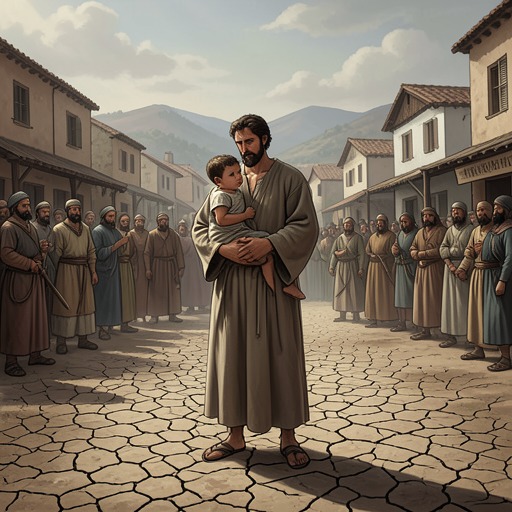
At the clearing Knecht has designated, he tells the assembled villagers that he has served as their Rainmaker for many years, that nothing he has tried now succeeds, and that he has offered himself to placate the demons. He names his son as the new Rainmaker, tells the people to follow Turu’s instructions after his death, and recommends Maro as his executioner. The tribal mother orders Maro to act, but the event’s significance lies in the way Knecht has taken the initiative: he accepts the community’s tradition, directs the succession, and gives the sacrifice a purpose beyond his own death. The custom thus appears both as a severe inherited response to collective desperation and as the framework within which Knecht makes his final act one of service.